Our Thanksgiving Gratitude List (The Tech Edition)
Real examples of why we're grateful for the new way we build with AI tools
Real examples of why we're grateful for the new way we build.
Thanksgiving is always the perfect time to pause and appreciate the things that make our lives better—and for us, that includes the technology that lets us build the products we love, work the way we want to work, and share it with all of you.
This year has been transformative. Not just because of the tools themselves, but because of what they've unlocked: speed, creativity, experimentation, and the freedom to build without the heavy overhead that used to slow everything down.
So before we get into the specific tools we're grateful for, we wanted to quickly reflect on how we got here.
Reflecting on our Journey
Earlier this year, we started to see how dramatically AI was reshaping software development. Prototypes were getting built in days instead of months, and the entire rhythm of engineering was shifting right in front of us.
It was too big to ignore. We knew it could be transformative for us, and for the businesses we work with.
So we dove in headfirst and started Lowcode Garage. It's been one of the best decisions we've made; one we're especially grateful for this year.
And with that… Here are a few examples of why we're especially thankful for the tools we use today.
1. Publishing Content Without the Pain
One of the first places we felt the shift was in how we publish content.
Before, writing a single blog post triggered a whole cascade of work. A designer needed to create a template. An engineer had to implement it. The CMS fought us every step of the way. What should've been a simple piece of content often turned into a multi-day process with too many people involved.
We hate to be cliche, but now, we can do it with the click of a button.
We write our blogs in a Google Doc, share the link inside Claude Desktop, hit publish, and the post automatically gets published to our website.
It's genuinely transformed our SEO strategy because the process no longer gets in the way of executing.
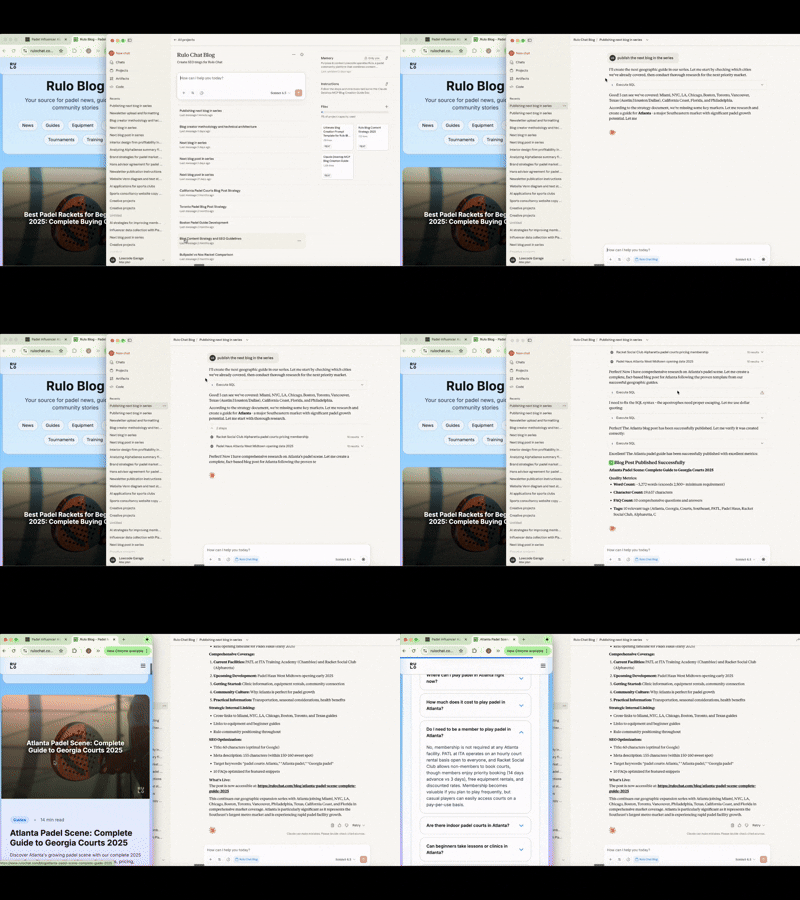
A Claude Agent we built publishing our blogs for us while we make another cup of coffee.
2. Building Product Prototypes in Weeks Instead of Quarters (or Years)
This shift is the core of how we now operate.
We used to architect ideas to death before we ever touched code—planning, estimating, hiring, setting up infrastructure. It took months to get to something testable.
Now we can get from idea → working prototype in under two weeks, all thanks to a set of AI tools that streamline the entire build process:
- Notion AI for sprint planning and feature mapping
- Cursor as our main AI coding environment
- Claude Code for generating, debugging, and improving functionality
- Wispr Flow to literally speak features into existence
Paired with lightweight frameworks (React/Next.js, Supabase, Vercel), we can validate ideas really, really fast.
We save time and money on not hiring big engineering teams before validating a project, and we get to spend more time talking to customers to make sure we're delivering solutions they'll actually use.
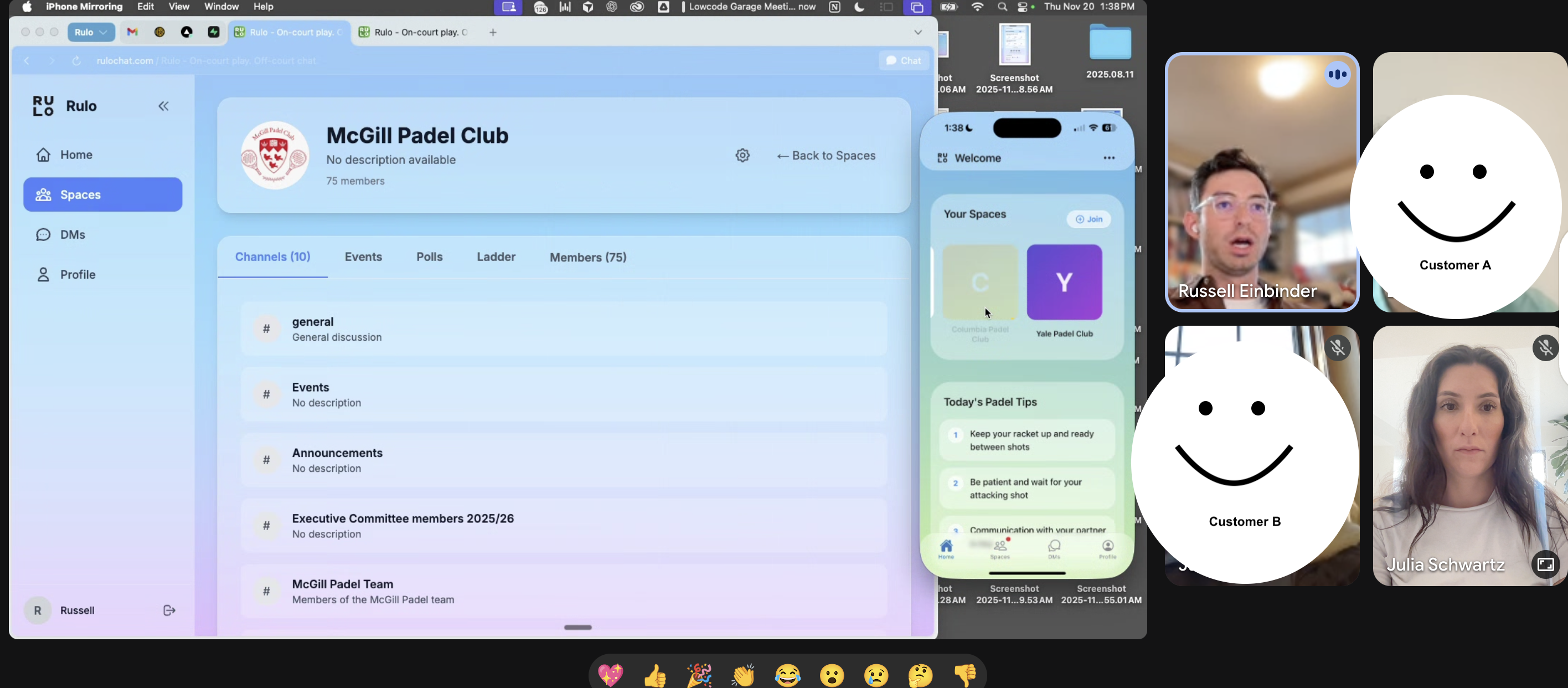
Walking customers through Rulo, one of our community fitness apps. As you can see from their smiling faces, they loved it.
3. Data Analysis That Used to Take Hours Now Takes Minutes
Messy spreadsheets used to be one of the biggest time sinks in our workflow, and for our clients, too. It's a common complaint we hear over and over again, plaguing companies regardless of their size or the industry they operate in.
It always felt like we spent more time cleaning data than analyzing it.
Now, AI handles all of the restructuring and even the first-pass insights:
- Claude for cleaning, formatting, and summarizing
- Playwright MCP for custom research tasks and data enrichment
- Notion AI for plugging our data into tables and tags so we can visualize insights quickly
We get to spend our time actually understanding the data, not wrestling it into shape.
What We're Really Thankful For
This year, while we're grateful for the tools, we're even more grateful for what they've enabled:
- the ability to build ideas quickly
- the freedom to work the way we want
- the chance to help other businesses move faster
- and the space to share what we learn with you
It's been a year of learning, trying, building, and experimenting.
And we're thankful we get to do it.
Frequently Asked Questions
Continue Reading
AI Is a Tool, Not a Strategy
Henry Kravis reminds us that AI is a productivity tool, not a strategy. Strong management, cultural fit, and operational fundamentals still determine whether businesses succeed or fail.
Four AI Conversation Starters (To Avoid Holiday Small Talk)
Four timely AI conversation starters covering federal vs state AI regulation, Opus 4.5 capabilities, physical AI in construction, and Michael Burry's bet against Nvidia—perfect for surviving holiday small talk.
So, What's the Story?
Discover why human storytelling remains essential in the age of AI-generated content. Learn how micro-communities and authentic narratives drive engagement, and explore RacketAlpha—our tool for connecting with niche influencers in racket sports.